
How the System Works
A job-site office or a new-home sales trailer often has a real restroom inside, with a flushing toilet and a sink. Without a sewer or water line, it needs two things: a fresh-water supply for the fixtures, and a waste holding tank that collects everything that drains out. A service truck pumps the tank on a schedule.
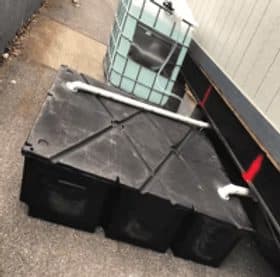
Our Holding Tank and Water Systems use low-profile tanks that sit under or beside the trailer, so there's no digging and nothing to remove but the tank when the job ends.
How Big a Tank: Florida's Table
Florida's rule sets the minimum holding tank capacity by how many people use it, assuming the tank is emptied twice a week. Pump more or less often and the required capacity scales with it.
Florida Table PR III: Minimum Holding Tank Capacity, Serviced Twice per Week
People Using It (8 Hours a Day): 1
- Minimum Capacity
- 125 Gallons
People Using It (8 Hours a Day): 2 to 3
- Minimum Capacity
- 250 Gallons
People Using It (8 Hours a Day): 4 to 5
- Minimum Capacity
- 500 Gallons
People Using It (8 Hours a Day): 6 to 7
- Minimum Capacity
- 750 Gallons
People Using It (8 Hours a Day): Over 7
- Minimum Capacity
- Add 125 Gallons per Additional Person
- A portable holding tank can't exceed 300 gallons of effective capacity, and no part of it can be more than 12 inches below the ground.
- More capacity for more people usually means more tanks, or pumping more often, rather than one bigger tank.
- Our 250-gallon low-profile tank measures about 6 ft by 3 ft 11½ in by 18 in and weighs about 100 lbs empty.
Service Schedule
Florida requires portable and stationary holding tanks to be serviced at least weekly, and the contents to be removed in their entirety when pumped. The right schedule depends on how many people use the trailer and how big the tank is. We set it with you and pump with our own trucks.
Placement and the Rules Around It
We handle the setup, the tank and the pumping. Tell us the trailer, the number of people, and how long you'll need it.
- Portable holding tanks must be rigid, watertight and used for a construction site or other temporary use, and removed when they're no longer needed.
- Each tank must show the service company's name and phone number.
- Where tanks are placed under the reduced setbacks the rule allows, they must sit in secondary containment that holds at least 110% of the tank's waste capacity.
- A stationary holding tank, or a restroom set up for permanent use, needs a state construction permit (DEP 4016) before it's installed. A temporary portable tank at a building site is a different case, so tell us how long the trailer will be there.
Related Pages
Sources
This guide explains the rules in plain language; it isn't legal advice. Local requirements can be stricter.