
Restrooms Are Required the Whole Time Workers Are There
Florida's rule is direct: portable restrooms, holding tanks or other restroom facilities must be provided at commercial and residential building sites for the duration of construction, any time workers are present, and they must stay accessible whenever the people who need them are on site.
The same rule says portable restrooms at building sites don't need a permit from the state, as long as they meet the rule's requirements. Placement on public property or in the right-of-way is a separate local question.
How Many Units: Florida vs. OSHA
Two sets of numbers apply, and Florida's is the stricter one for most crews.
Minimum Restrooms by Crew Size
Crew Size: Up to 10
- Florida (Table PR II, Weekly Service)
- 1
- OSHA (29 CFR 1926.51)
- 1
Crew Size: 11 to 20
- Florida (Table PR II, Weekly Service)
- 2
- OSHA (29 CFR 1926.51)
- 1
Crew Size: 21 to 40
- Florida (Table PR II, Weekly Service)
- 3 to 4
- OSHA (29 CFR 1926.51)
- 1 Seat and 1 Urinal per 40 Workers
Crew Size: 41 to 50
- Florida (Table PR II, Weekly Service)
- 5
- OSHA (29 CFR 1926.51)
- 1 Seat and 1 Urinal per 40 Workers
Crew Size: Over 50
- Florida (Table PR II, Weekly Service)
- 5, Plus 1 for Every 10 More People
- OSHA (29 CFR 1926.51)
- Per 40 Workers; Per 50 Over 200
- Florida's counts assume weekly service. Service twice a week and the rule lets you halve the count; three or more times a week, divide by three, rounded up.
- If one contractor has several building sites, Florida counts them as a single site for sizing, and units can be shared between sites as long as they're no more than 300 feet from any site they serve.
- OSHA's rule doesn't apply to mobile crews that have transportation readily available to nearby toilets. A crew that reports to one site for days or weeks isn't a mobile crew.
Service Is Part of the Requirement
Florida requires portable restrooms to be serviced at least weekly, with the inside cleaned on every visit and the tank charged with sanitizer-deodorizer. OSHA has said in a formal interpretation that a toilet in unsanitary condition doesn't count toward the required number. A dirty unit is, for compliance purposes, a missing unit.
That's why our crews follow the same Standard Service Protocol on every visit, not just a pump-out. Busy sites and summer heat usually call for service more than once a week.
High-Rise Work: Toilets Have to Be Reachable
OSHA has said the standard requires toilets close enough that workers can use them when they need to. On a tower where the only way down is the stairs, restrooms only on the ground floor may not meet that test.
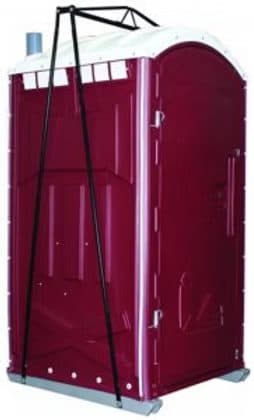
The fix is putting units on the working floors. Our high-rise kits bolt a steel lifting sling to a standard unit so a crane can set it on upper levels. See Accessories and Supplies.
Handwashing on the Job
OSHA requires adequate washing facilities for workers applying paints, coatings, herbicides or insecticides, or doing other work where contaminants could be harmful, close to where they work. Florida's rule sets one hand washing station for every ten restrooms required at remote locations and requires them where food is served.
Our foot-pump Handwashing Stations cover both, and in-unit sinks are available for crews that prefer them.
Office and Sales Trailers
A trailer with a restroom inside still needs water in and waste out. Florida limits portable holding tanks to 300 gallons, requires them to be serviced at least weekly, and sizes them by how many people use them. Our guide to Holding Tanks for Office Trailers walks through it.
Related Pages
Sources
- Florida Administrative Code Rule 62-6.0101: Portable Restrooms and Portable or Stationary Holding Tanks (Florida DEP)
- OSHA 29 CFR 1926.51: Sanitation (Construction)
- OSHA Interpretation: Unsanitary Toilets Don't Count Toward the Required Number (May 17, 2006)
- OSHA Interpretation: Toilets Must Be Promptly Accessible, Including on High-Rise Floors (Feb. 23, 2005)
This guide explains the rules in plain language; it isn't legal advice. Local requirements can be stricter.